
Start with the shared foundation
SEO, AEO, and GEO are connected practices, not three unrelated checklists. They all depend on a healthy website: useful pages, clear information architecture, fast loading, accessible markup, accurate facts, and content that helps a visitor. If those basics are weak, extra optimisation language will not create durable visibility.
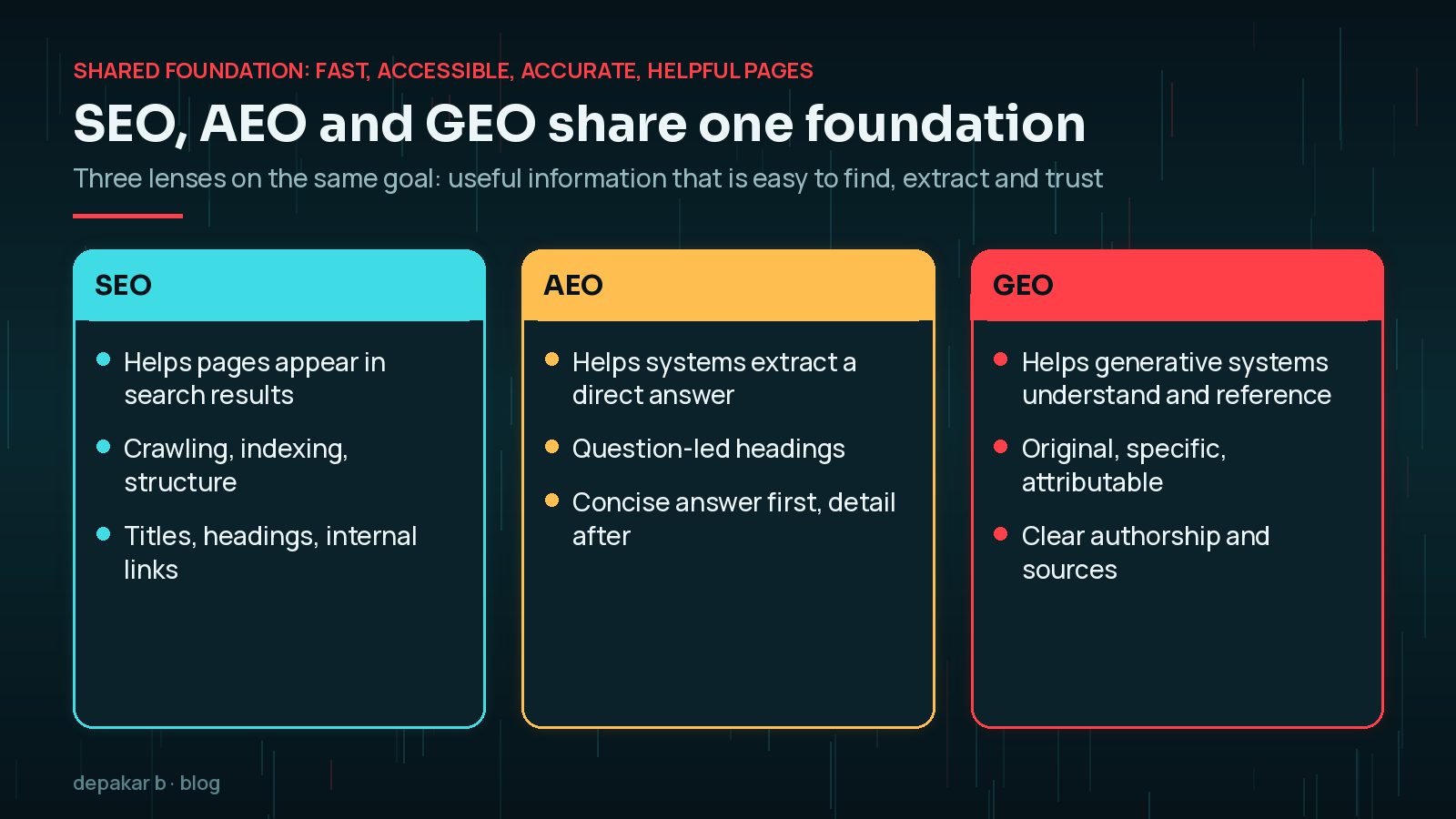
SEO helps pages appear in search results. AEO helps systems extract a direct answer. GEO helps generative systems understand, trust, and reference information. The best work starts with the user’s need and makes the answer clear enough for many discovery systems to use.
Begin with the WordPress technical SEO checklist and the performance guide when foundations need fixing before strategy language.
What SEO still means
Search engine optimisation helps search engines crawl, interpret, and rank a page for relevant queries. It includes site structure, indexing controls, canonical URLs, redirects, structured data where appropriate, mobile experience, performance, internal linking, useful titles, logical headings, topical depth, and evidence.
SEO is not just keywords
Keywords matter because they reveal the language people use, but a page is not useful because a phrase is repeated. A strong page answers the reason behind the query. Someone searching for WordPress performance optimisation may want a diagnosis, implementation support, or a checklist. The page should make its audience, promise, process, and next step obvious.
Technical priorities
- Make important pages discoverable with internal links and a correct XML sitemap.
- Use one clear topic with a descriptive title and meaningful H1.
- Keep headings logical and use them to organise real information.
- Optimise images, scripts, caching, and delivery for real devices.
- Use Google Search Console to see indexing, queries, clicks, and issues.

What AEO adds
Answer Engine Optimisation makes content easy for answer-oriented systems to extract and present. This includes featured snippets, voice interfaces, assistant results, and search experiences that answer a question before a visitor clicks. AEO rewards direct, well-structured explanations.
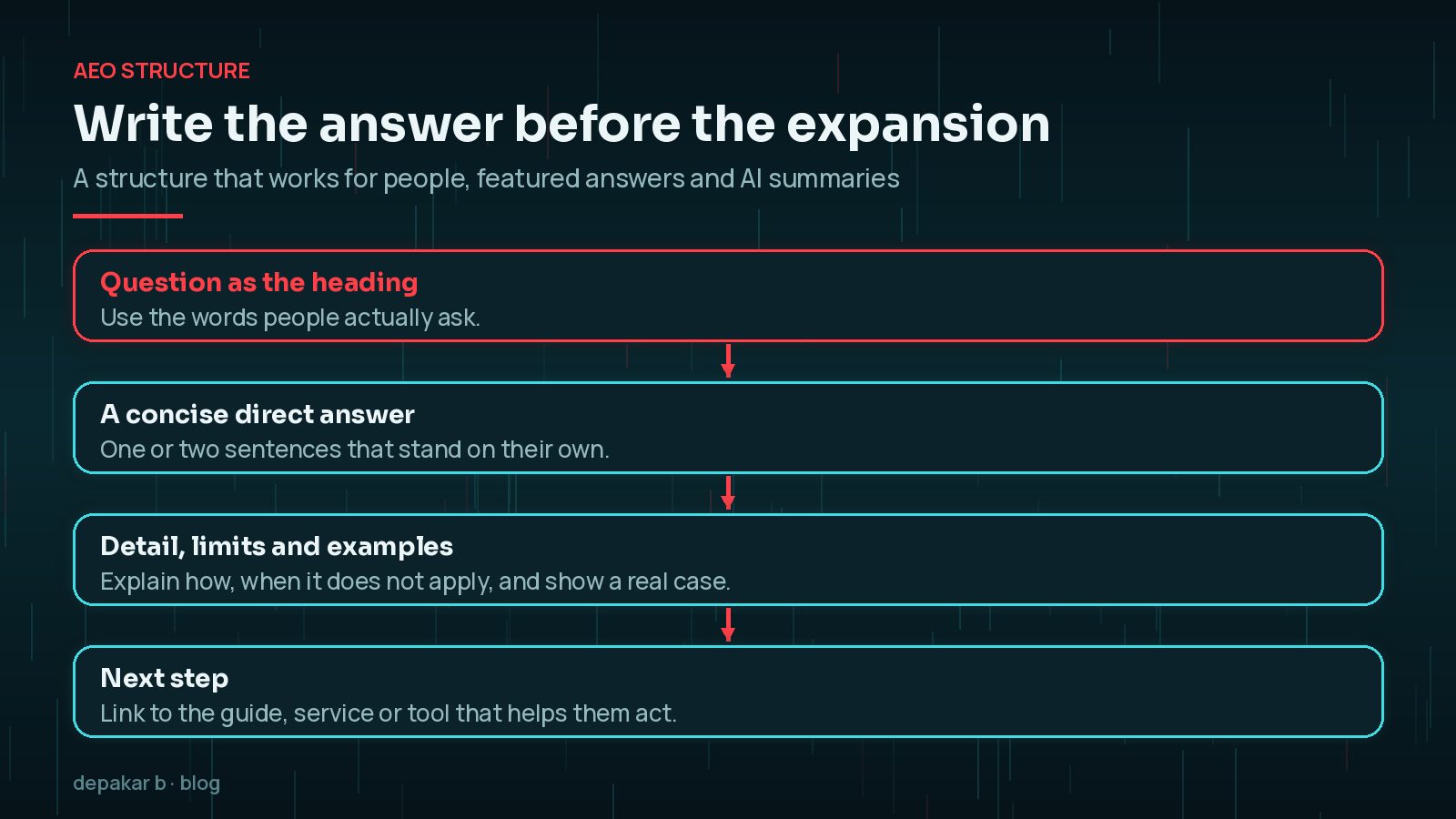
Write the answer before the expansion
When a heading asks a real question, begin with a concise answer. Then explain the detail, limitations, examples, and next steps. This is clearer for people and easier for answer systems to interpret. A good FAQ answers the question in the first sentence rather than postponing the useful information below marketing language.
What GEO adds
Generative Engine Optimisation is an emerging practice around how AI systems retrieve, synthesise, and reference information. There is no reliable shortcut that guarantees an AI mention. The durable qualities are original knowledge, transparent authorship, current facts, clear citations where relevant, well-organised pages, and a consistent entity presence across the web.
Build content worth citing
A shallow page that repeats common advice gives a system little reason to use it. A useful page explains its method, includes concrete examples, distinguishes fact from opinion, names the author or company, and links to primary evidence when appropriate. For a business, this can mean useful service detail, approved case studies, honest buyer answers, and consistent company information.

One workflow for SEO, AEO, and GEO
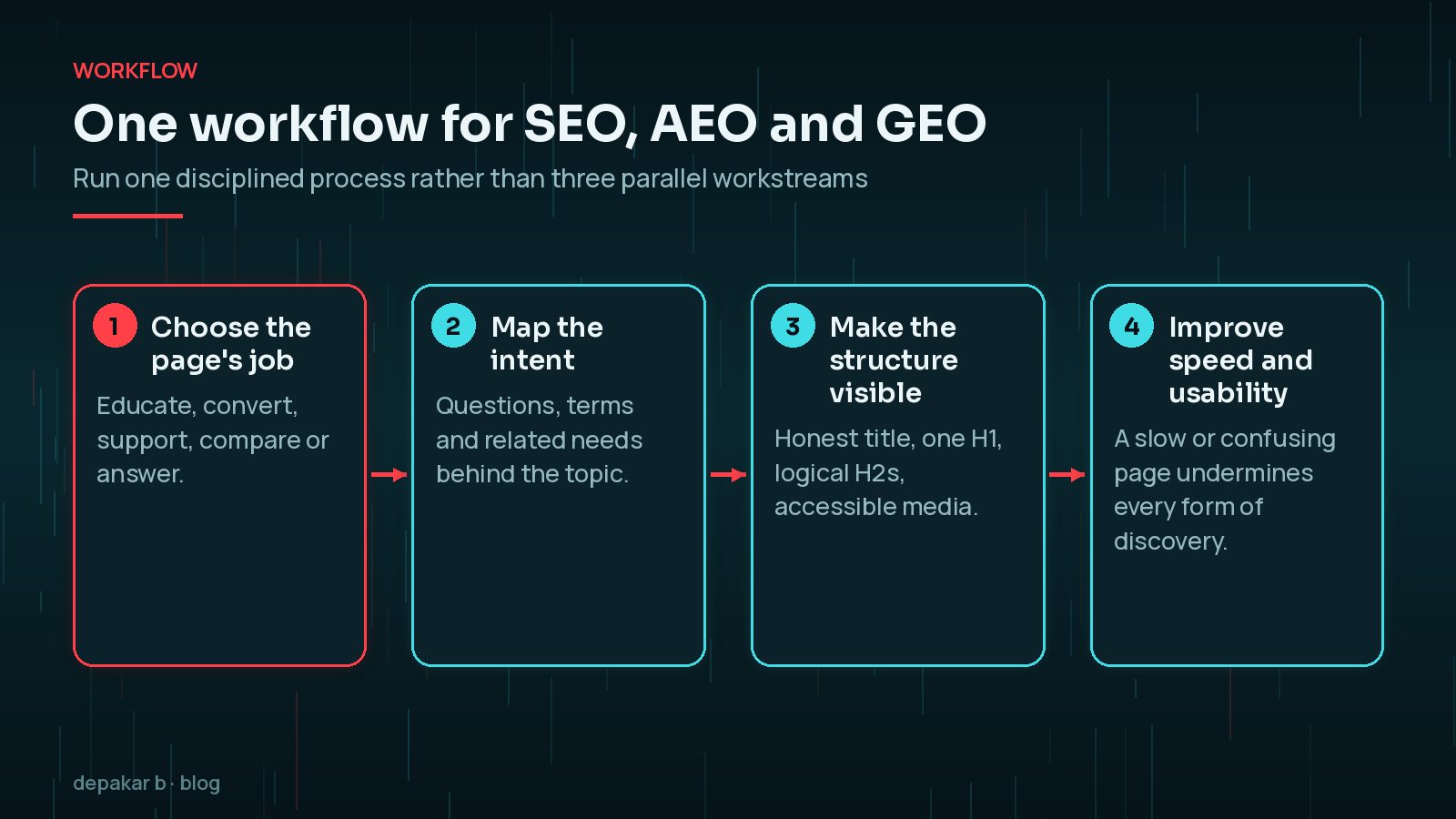
Use one disciplined workflow rather than three parallel workstreams. First understand the business goal and the user’s question. Audit technical foundations: pages, crawlability, performance, mobile behaviour, internal links, and tracking. Improve page structure so headings create a logical journey. Write direct answers and expand them with useful context. Then measure what changes.
- Choose the page’s job. Educate, convert, support, compare, or answer a specific question.
- Map the intent. Look at the questions, terms, and related needs behind the topic.
- Make the structure visible. Use an honest title, one H1, logical H2s, descriptive links, and accessible media.
- Improve speed and usability. A slow or confusing page undermines every form of discoverability.
Mobile journeys and forms often decide whether discovery turns into a lead. See AMP and mobile page experience and forms and integrations planning when those layers matter.
Measure and improve
Launching is not the end of optimisation. Performance data, Search Console, analytics, real user behaviour, and technical audits show what needs attention next. Do not change everything at once. Make a prioritised change, document it, and observe the outcome. This builds a reliable improvement loop instead of random activity.
How do Google's AI features use your content?
Google's guidance for site owners on AI features such as AI Overviews and AI Mode is refreshingly plain: the usual SEO best practices still apply, and there are no additional requirements or special optimisations needed to appear. To be shown as a supporting link, a page must be indexed and eligible to appear in Search with a snippet. Google also states that you do not need new machine-readable files, AI text files or special schema.org markup.
Google describes these features as using a "query fan-out" technique, issuing related searches across subtopics to build a response. In practice, that rewards sites that cover a topic properly: a clear main page supported by related pages that answer the follow-up questions, all connected with descriptive internal links.
How do you measure visibility in AI search?
Measurement is still catching up, so combine sources rather than relying on one number. According to Google, traffic from AI Overviews and AI Mode is included in the Search Console Performance report under the "Web" search type, alongside classic results. That means you will not always see it separately, but you will see its effect on clicks and impressions.
- Compare impressions, clicks and average position for your key pages over equal periods.
- Track conversions and engagement in your analytics, not only visits.
- Ask new enquiries how they found you; AI assistants increasingly appear in the answers.
- Search your main topics in AI features yourself and note which sources are cited.
If clicks fall while rankings hold steady, read rankings held but clicks dropped before changing anything. And if you are weighing whether to opt out of AI features altogether, the new Search Console setting explains what it does and does not change.
What does this mean for WordPress sites specifically?
WordPress makes good discoverability achievable without custom engineering, but the defaults need attention. Check that your theme outputs one meaningful H1 per page, that categories and tags are not creating thin duplicate archives, and that your SEO plugin's schema output matches what is actually on the page. Author pages and an honest About page help with the "who is behind this" question that matters to people and to AI systems alike. Finally, keep the site fast and secure, because a slow or compromised site loses trust long before any algorithm weighs in. For hands-on help, see my SEO improvement service.
Trust is the long-term advantage
Do not publish AI-generated pages without review, evidence, and a real point of view. Do not add FAQ schema when the page lacks genuine questions and answers. Do not chase every acronym while ignoring broken links, missing titles, poor mobile behaviour, or unclear conversion paths. The most sustainable strategy is to make each important page demonstrably useful.
SEO, AEO, and GEO are different lenses on the same responsibility: publishing information that is useful, structured, fast, credible, and easy to understand. Build for people first, make the technical foundation strong, and improve with evidence. Explore how that shows up in WordPress development and the rest of the blog.
Frequently Asked Questions
What is the difference between SEO, AEO and GEO?
SEO helps pages appear in search results, AEO helps systems extract a direct answer, and GEO helps generative AI systems understand, trust and reference your content. They rely on the same foundation of useful, well-structured, fast and accurate pages.
Do I need special optimisation to appear in Google AI Overviews?
No. Google says there are no additional requirements or special optimisations for AI Overviews or AI Mode. A page must be indexed and eligible to show with a snippet, and normal SEO best practices apply.
Do I need an llms.txt or AI text file for GEO?
Google's documentation says you do not need new machine-readable files, AI text files or special markup to appear in its AI features. Other AI services may have their own guidance, but no file replaces helpful content.
Is FAQ schema still useful for AEO?
Google stopped showing FAQ rich results in May 2026. Real question-and-answer sections still help readers and make answers easy to extract, but only add FAQ markup that matches genuine visible content.
How do I track traffic from AI Overviews?
Google includes AI Overviews and AI Mode traffic in the Search Console Performance report under the Web search type. Combine it with analytics conversions and the questions new enquiries ask to understand the impact.
Final Thoughts
Labels will keep changing, and new acronyms will follow GEO. The work underneath them is stable: understand what people need, answer it clearly, structure it so machines can read it, prove why you are worth trusting, and keep the site fast and healthy. Do that consistently on WordPress and you are building for classic search, answer engines and generative AI at the same time.
Official References
Sources checked on 29 October 2026:
- Google Search Central: AI features and your website
- Google Search Central: SEO Starter Guide
- Google Search Central: Creating helpful, reliable, people-first content
- Google Search Central: Introduction to structured data
- Google Search Central: Spam policies
- Google Search Central: Documentation updates (FAQ rich result removal)
- Bing Webmaster Guidelines