
If you've asked around about WordPress SEO services cost, you've probably had answers ranging from a small one-off fee to a large monthly retainer. Both can be reasonable, and both can be poor value. What you are paying for depends on what "SEO" means in the proposal, how big and competitive your market is, and what state your site is in today.
This guide doesn't give you a price list. Any figure without your site and goals would be a guess. Instead it explains what SEO covers, what changes the scope, what you can do yourself, and the red flags Google itself warns about.
What "SEO" Actually Covers
Google describes search engine optimisation as helping search engines understand your content and helping people find your site. In practice, SEO work falls into three groups, and proposals often price them differently.
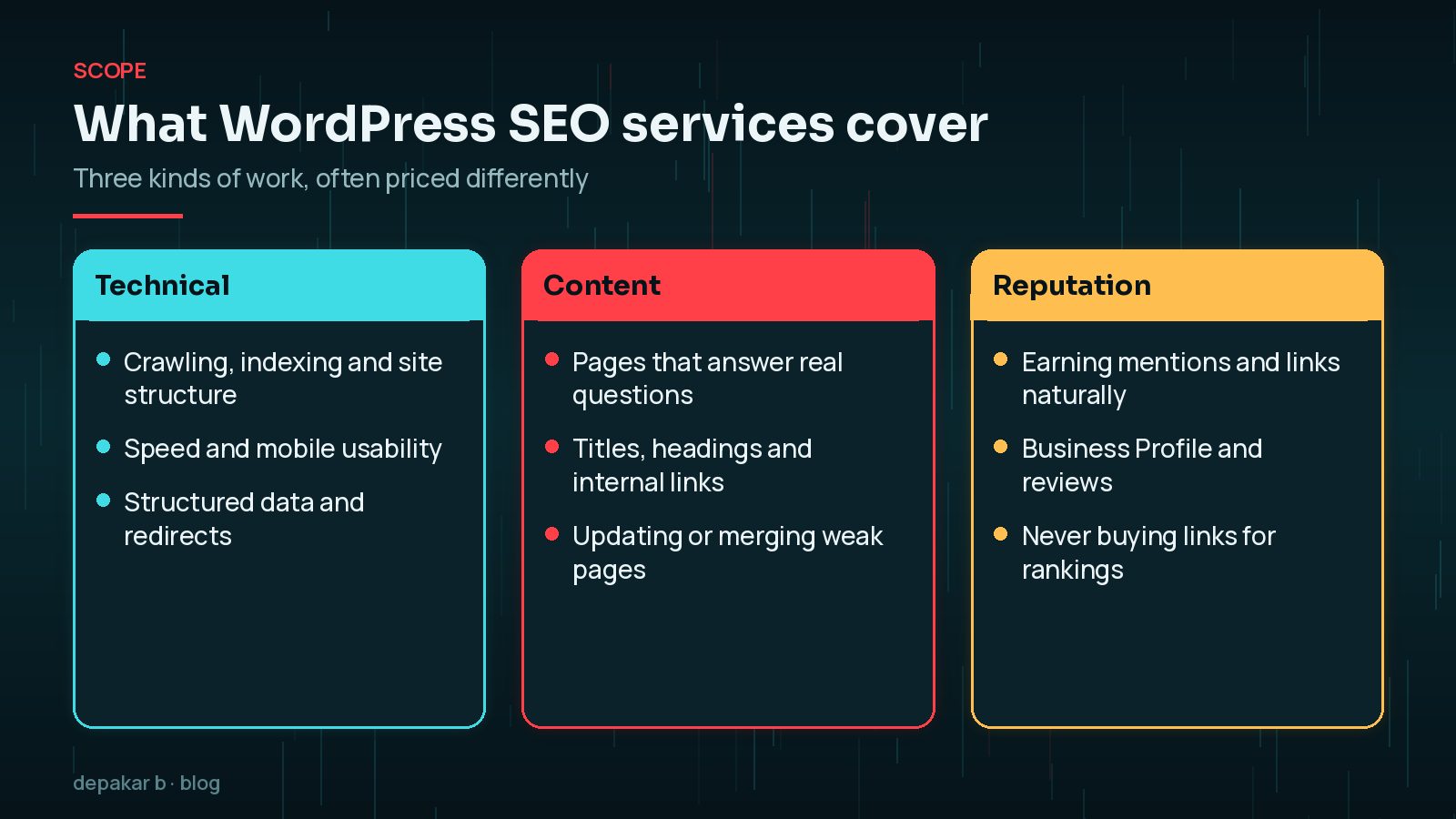
- Technical SEO: making sure Google can crawl and index your pages, fixing site structure, redirects, speed and mobile issues, and adding accurate structured data.
- Content: pages that answer the questions your customers actually ask, with clear titles, headings and internal links. It also means improving or merging weak pages.
- Reputation: earning mentions and links naturally, plus local signals such as your Business Profile and reviews.
A proposal that only covers one of these can still be right for you, as long as you know what is and isn't included.
One-Off Audits vs Ongoing Work
There are two common ways to buy SEO help.
- A one-off technical SEO audit reviews your site and gives you a prioritised list of fixes. Google's guidance says an audit should give you realistic estimates of improvement and of the work involved. It suits sites that need a clear plan, or that have an in-house person to carry it out.
- Ongoing work covers implementing fixes, creating or improving content, monitoring and reporting over months. It suits competitive markets and sites where content needs to keep growing.
Many businesses start with an audit, fix the most important issues, then decide whether ongoing help is worth it. My article on technical SEO improvements that matter shows the kinds of fixes an audit usually finds.
Access tip from Google: if someone offers an audit, give them read-only access to Search Console at that stage, not full or owner access.
Factors That Change WordPress SEO Services Cost: Size, Competition and History
These factors change how much work is needed more than anything else.
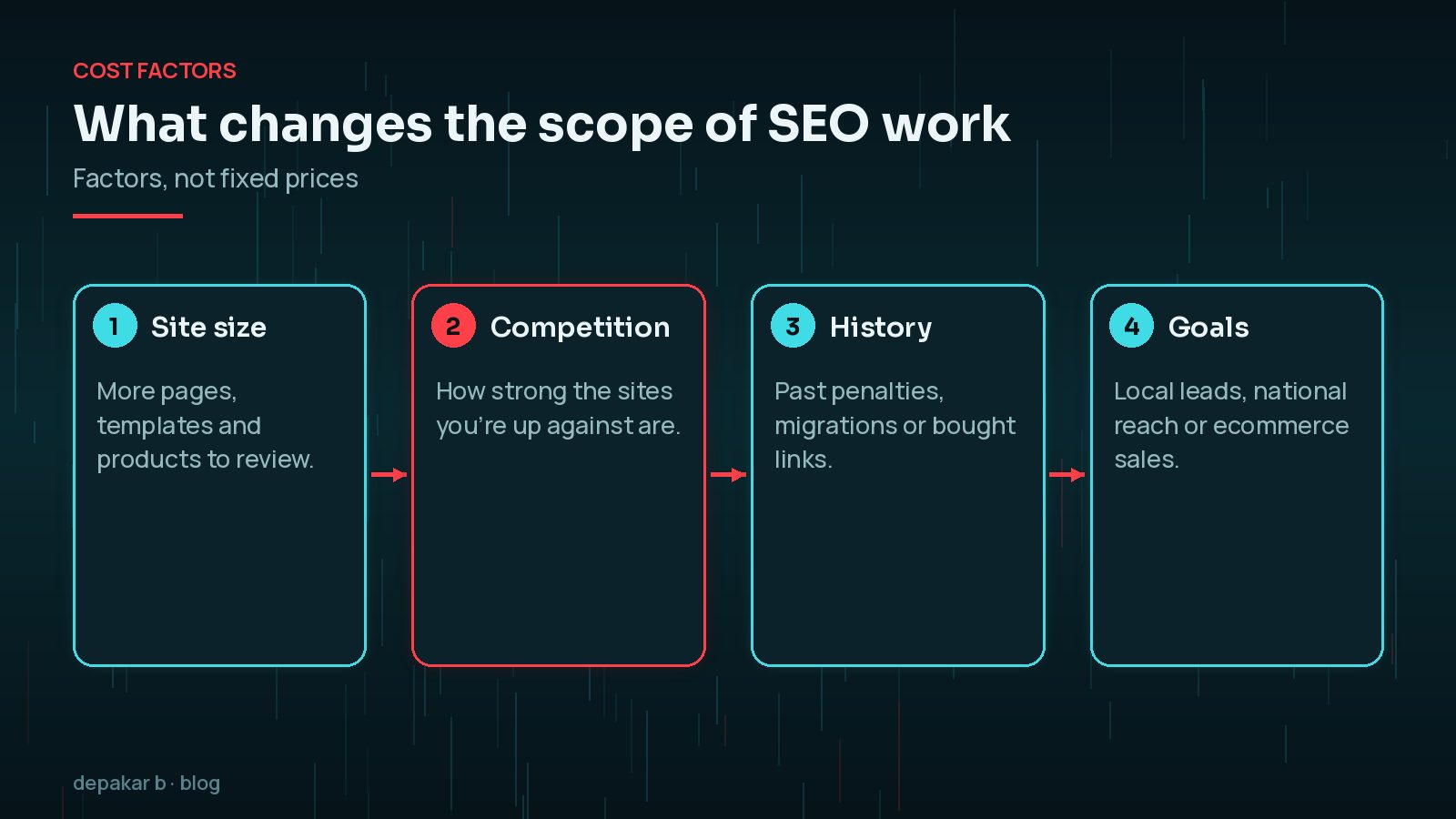
- Site size. A ten-page service site and a shop with thousands of products need very different amounts of review, templates and fixes.
- Competition. A local plumber in a small town faces different competition from a national ecommerce brand. Stronger competitors usually mean more content and more time.
- History. Past site migrations, manual actions, hacks or bought links all add clean-up work before progress is possible.
- Goals. Local leads, national reach and ecommerce sales need different strategies. Local businesses should read my guide to local SEO on WordPress.
- Who does the work. If you or your team can write content and make changes, the cost of outside help drops.
Technical Fixes vs Content vs Links
It helps to know where effort typically goes, so you can judge whether a proposal is balanced for your site.

- Technical fixes are often front-loaded. Once the site is crawlable, fast and well structured, ongoing technical work is usually smaller.
- Content is where most ongoing effort goes on many sites. Google's SEO starter guide says content people find compelling and useful will likely influence your presence in search more than any of its other suggestions.
- Links should come from genuinely useful content and real relationships. Buying links to manipulate rankings is listed as link spam in Google's spam policies.
For a WordPress-specific view of the technical side, see my WordPress technical SEO checklist.
What You Can Do Yourself (DIY SEO vs Hiring)
Google's starter guide is written for site owners, and plenty of SEO is within reach without hiring anyone:
- Set up Search Console and check that your important pages are indexed.
- Write clear, unique titles and meta descriptions for key pages.
- Make sure each service or product has its own useful page.
- Add descriptive alt text to important images.
- Link related pages to each other with descriptive anchor text.
- Keep your Business Profile accurate if you serve local customers.
Hiring makes sense when the technical problems are beyond your comfort zone, when you are in a competitive market, when a migration is planned, or when your time is better spent elsewhere. Google notes that hiring a professional can save time, but an irresponsible SEO can damage your site and reputation.
Red Flags: Guarantees and Cheap Link Packages
Google's guide to hiring an SEO is unusually direct about what to avoid.
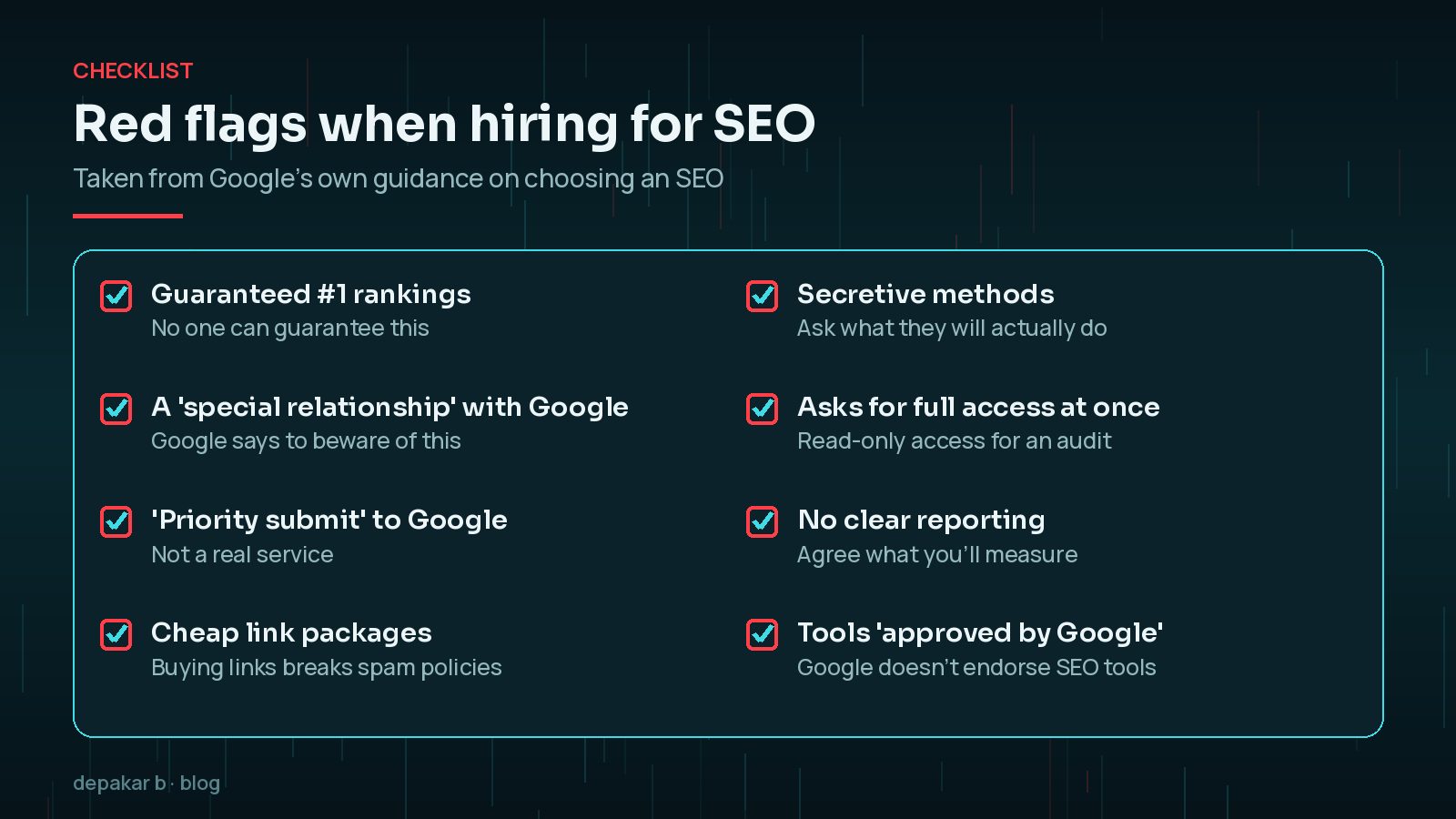
- Guaranteed rankings. Google says no one can guarantee a #1 ranking on Google.
- A "special relationship" with Google or a "priority submit" service. Google says to beware of both.
- Cheap link packages. Buying or selling links for ranking purposes is link spam, and can lead to lower rankings or removal from results.
- Secrecy. If a company won't clearly explain what it will do, ask for explanations or look elsewhere.
- "Google-approved" tools. Google says it doesn't endorse third-party SEO tools.

If a previous provider bought links or published thin content, recent spam updates may already have affected you. See my guide to recovering from the September 2026 spam update.
How to Measure If It's Working
Agree what you will measure before work starts, and look at trends over months rather than days.
- Search Console performance: impressions and clicks for the pages and queries that matter to your business.
- Indexing: whether your important pages are indexed, and whether issues are falling.
- Leads and sales from organic search in your analytics, which matter more than rankings alone.
- Work delivered: a clear log of what was changed and when, so results can be connected to actions.
Rankings for a few vanity keywords are a weak measure on their own. Ask for reports that link work done to enquiries or revenue where possible.
Frequently Asked Questions
How much do WordPress SEO services cost?
It depends on scope: site size, competition, site history, goals and how much work you do yourself. Ask for a proposal that lists the work included rather than comparing headline prices.
Do I need an SEO expert?
Not always. Google's starter guide covers a lot that site owners can do themselves. An expert helps with complex technical issues, competitive markets, migrations, or when your time is better spent elsewhere.
What is a technical SEO audit?
A review of how well search engines can crawl, index and understand your site, with a prioritised list of fixes. Google says it should include realistic estimates of improvement and the work involved.
Can anyone guarantee first place on Google?
No. Google states that no one can guarantee a #1 ranking, and advises caution with any SEO that claims to.
Are cheap link-building packages worth it?
Usually not. Buying links to manipulate rankings breaks Google's spam policies and can harm your rankings.
Final Thoughts
WordPress SEO services cost what the scope demands: the size of your site, the strength of your competition, your history and your goals. Start by understanding what work is actually needed, do the parts you can yourself, and steer clear of guarantees and link packages.
If you'd like a clear view of what your site needs, my SEO improvement service starts with an honest audit.
Pay for clearly defined work, measured by results that matter to your business.
Official References
Sources checked on 29 October 2026: