
If you want to get cited in AI Overviews and AI Mode, the good news is that there is no secret file, plugin or special markup to add. Google's own guidance says the same SEO fundamentals apply. What has changed is how often, and how prominently, Google shows the links it cites.
On Google announced more inline links, a test of a dedicated "official websites" section, and wider news carousels in its AI search features. This guide explains what that means for your site and what you can do about it this month.

What Changed in AI Overviews and AI Mode Links on 15 October 2026?
Google's announcement, More ways to connect with the web from Search, listed several updates to AI Overviews and AI Mode:
- More inline links. Links embedded in words or phrases inside the AI response. Google says it has made "continued and substantial increases" to these and is showing them higher up in responses more often.
- An "official websites" section (in testing). For tasks where there are only one or two official places to go, Google is testing a dedicated section at the top of the response, with context about why each link is useful.
- News carousels in more places. Carousels for timely articles are rolling out to more locations and languages, and they highlight a searcher's Preferred Sources.
- More visual related-article links with images and thumbnails.
- Clickable creator names on video results in AI Mode, linking to Search profiles (in testing).
Some of these are tests, not full launches, so you may not see all of them for every query or country. Treat them as a direction of travel rather than a guaranteed layout.
How Does Google Choose Which Pages to Cite?
Google's Search Central page on AI features is unusually direct. To be eligible as a supporting link in AI Overviews or AI Mode, a page must be indexed and eligible to be shown in Google Search with a snippet. Google states there are no additional technical requirements.
Google also explains that both features may use a "query fan-out" technique. The system runs several related searches across subtopics, then picks supporting pages from those results. In practice, that means a page can be cited for a question it does not rank first for, as long as it answers one clear part of it well.
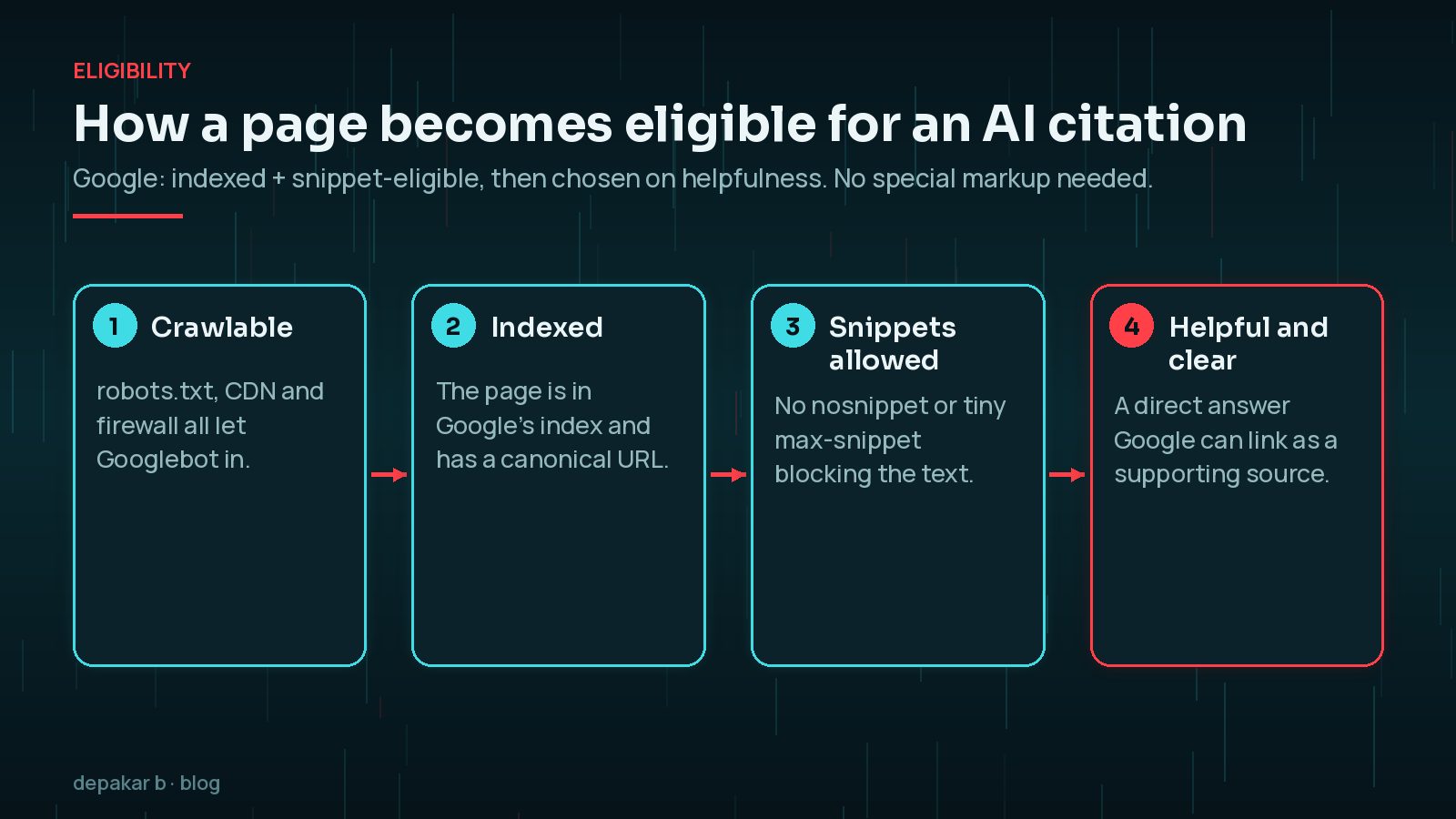
Being eligible does not guarantee anything. Google repeats that crawling, indexing and serving are never guaranteed. Your job is to remove the reasons not to cite you, then make the page the clearest answer available.
Is Being Cited the Same as Getting Clicks?
No, and it is worth being honest about this. A citation is an impression; a click is a choice the searcher makes afterwards. Google says clicks from results pages with AI Overviews tend to be higher quality, with people spending more time on the site. Industry commentary, including Search Engine Land's write-up of the October changes, questions whether more links will actually lead to many more clicks.
Both can be true. For a service business, a smaller number of better-informed visitors can still mean more enquiries. The point is to measure leads and sales, not just visibility.
Make Task Pages the 'Official' Answer
The new official-websites test is aimed at task queries: booking, paying, checking a status, finding opening hours, downloading a form. If your business is the official place to do something, make it obvious.

- One page per task. "Book a repair", "Request a quote", "Pay an invoice". Do not hide the task halfway down a long services page.
- Say what the page does in plain words. Put the task in the title tag, the H1 and the first sentence.
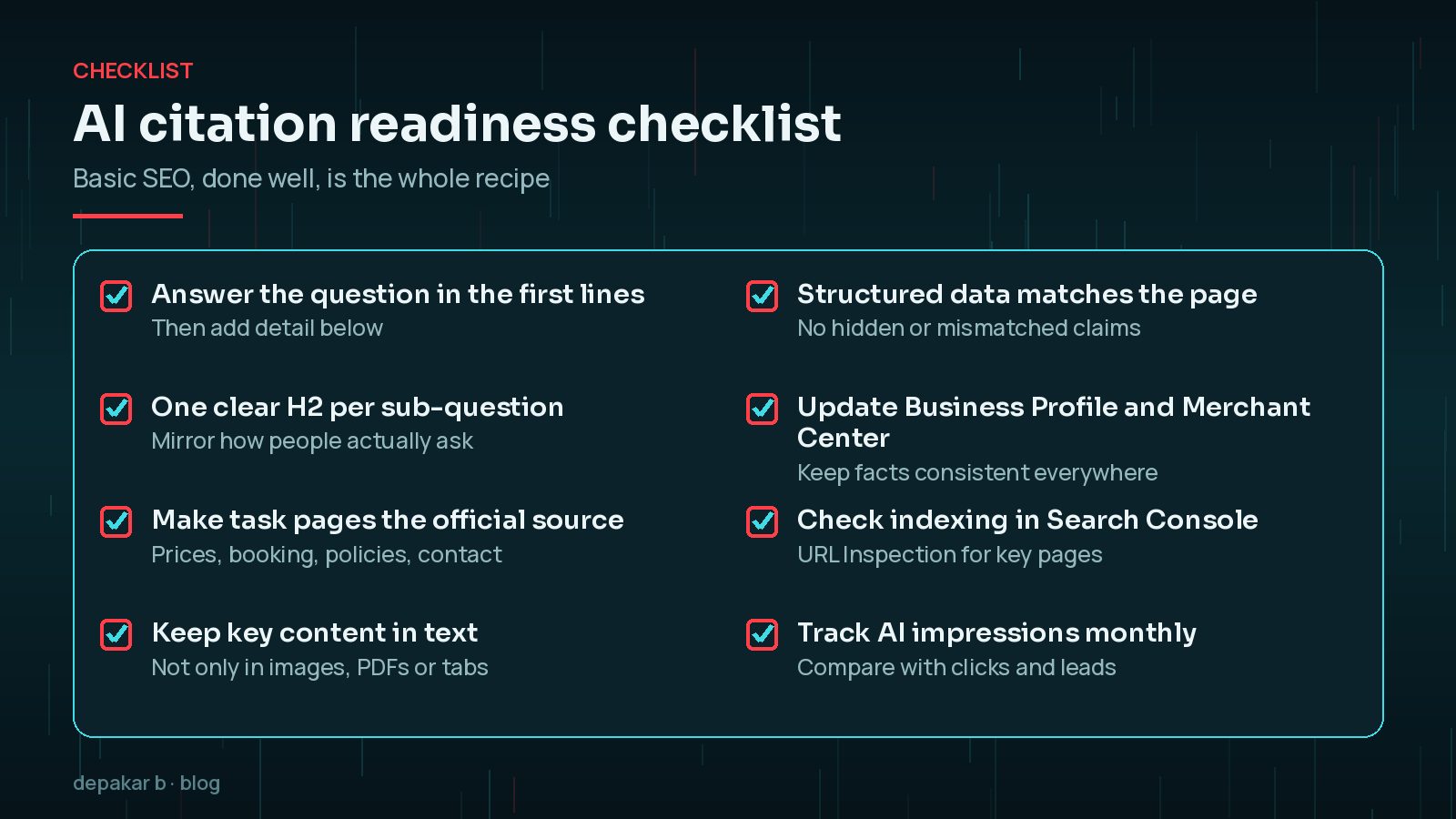
- Keep facts consistent. Your name, address, phone, hours and prices should match across the site, your Google Business Profile and, for shops, Merchant Center. Google's guidance specifically mentions keeping those up to date.
- Link to the task page from your navigation or footer, so it is easy for both people and crawlers to find.
Content Structure That Helps You Get Cited in AI Overviews
AI answers lift short, self-contained statements. You do not need to write for robots, but you can make your best answers easy to find.
- Answer first, then explain. Open each section with one or two sentences that directly answer its heading.
- Use question-style H2s that match how people ask, such as "How long does a site migration take?"
- Keep key content in text. Google lists "making sure that important content is available in textual form" as a best practice. Prices hidden in images or PDFs are harder to use.
- Support text with good images and video where they genuinely help, with descriptive alt text.
- Show who wrote it and why they know. A real author, real experience and up-to-date dates help people trust the page, even if no single signal is a ranking switch.
Structured data still helps Google understand the page, but it must match the visible text. There is no special AI schema. My upcoming guide to WordPress schema markup covers what is worth adding. Likewise, Google says you do not need new AI text files to appear in its features, which is why I treat llms.txt on WordPress as optional rather than essential.
For the broader picture of answer-ready content, see my SEO, AEO and GEO guide.
Technical Basics: Crawlable, Indexable, Snippet-Eligible
Most "why aren't we cited?" problems turn out to be ordinary technical issues. Check these first:
- Crawling is allowed. Check
robots.txt, and also your CDN or security firewall. Google explicitly mentions hosting infrastructure blocking crawlers. - The page is indexed. Use the URL Inspection tool in Search Console for your key pages.
- Snippets are allowed. A
nosnippetrobots meta tag, an overly smallmax-snippetvalue, or largedata-nosnippetsections limit what Google can show, in AI features as well as normal results. - The page is findable through internal links, not only through the sitemap.
- Page experience is reasonable on mobile: fast enough, stable, and usable.
Check your security plugin and CDN. Aggressive bot protection sometimes blocks or challenges Googlebot. If URL Inspection shows the page cannot be fetched, fix that before touching any content.
How to Track AI Citations and Traffic
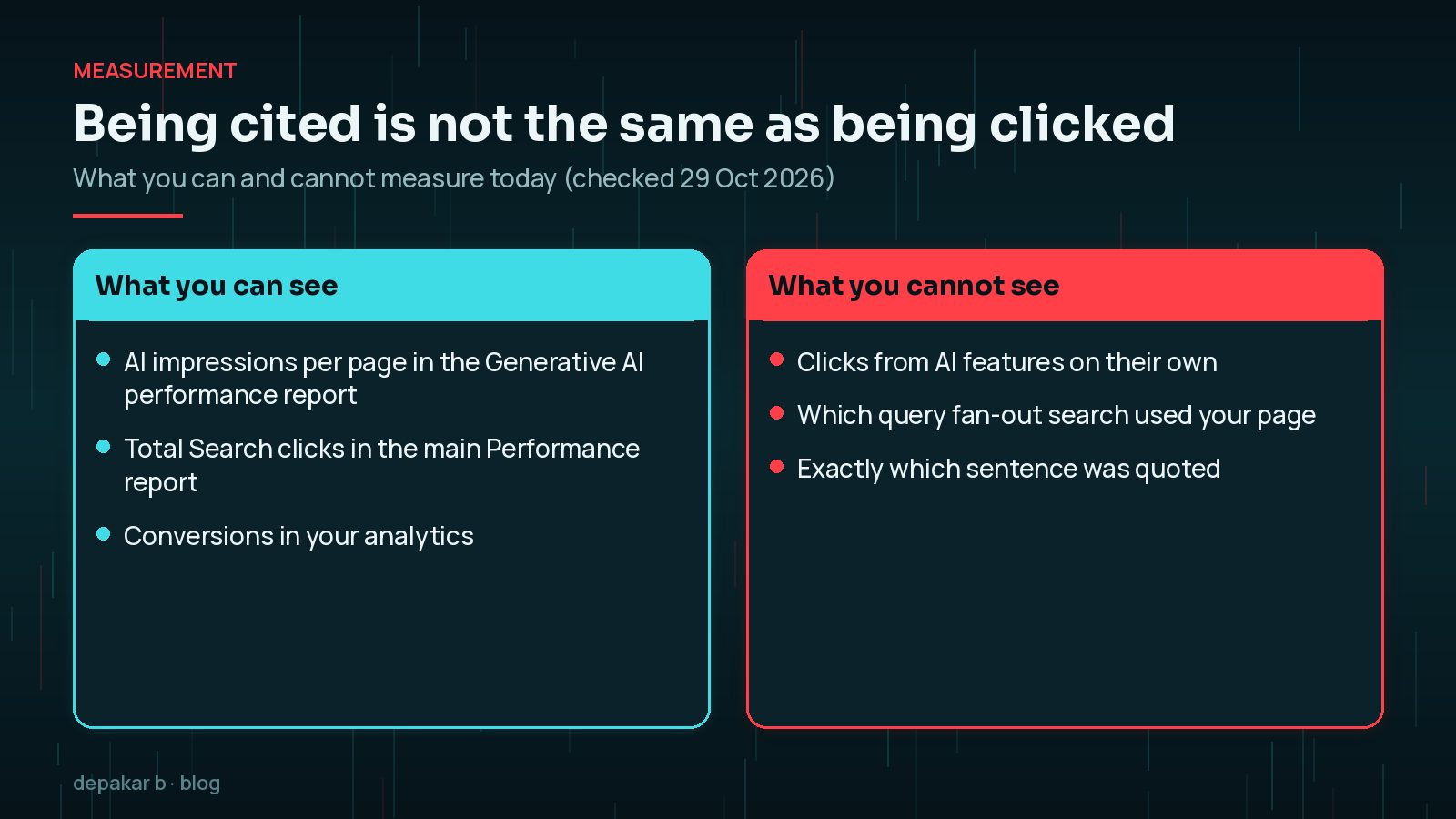
Search Console now has a Generative AI performance report. Google's help page says it rolled out to all websites worldwide as of . It shows impressions from AI Overviews and AI Mode, and you can group them by page, country, device and date.
A simple monthly routine:
- Open the Generative AI performance report and sort pages by impressions.
- Note which pages gain or lose AI impressions after the 15 October changes.
- Compare with the main Performance report for the same pages. AI feature traffic is included in the "Web" search type there.
- Check enquiries, calls or sales for those pages in your analytics.
- Improve the pages that get AI impressions but few clicks: sharpen the answer, add a clear next step, and make the task obvious.
Frequently Asked Questions
Do I need special schema or an AI file to get cited in AI Overviews?
No. Google's AI features documentation says there are no additional requirements, no special schema.org structured data and no new machine-readable or AI text files needed. Normal SEO best practice is what counts.
Why is my page ranking but not cited in AI Overviews?
AI Overviews only appear on some queries, and they may use query fan-out to pick supporting pages from related searches. Check the page is indexed and snippet-eligible, then make sure it answers one clear question directly near the top.
Can I see clicks from AI Overviews in Search Console?
As of 29 October 2026, the Generative AI performance report shows impressions, not a separate click count. AI feature traffic is included in the normal Performance report under the Web search type.
What is the official websites section in AI Mode?
Google announced on 15 October 2026 that it is testing a dedicated section at the top of some AI responses that highlights the one or two official places to complete a task, with context about why each link is useful.
Will blocking snippets stop my site appearing in AI features?
Google says nosnippet, data-nosnippet, max-snippet and noindex limit what is shown from your pages in Search, including AI features. They also affect normal snippets, so use them carefully.
Final Thoughts
You cannot force Google to cite you, but you can remove every reason not to. Make sure your pages are crawlable, indexed and snippet-eligible, write answers that are clear and quotable, and make task pages unmistakably official.
The 15 October updates mean more links in AI answers. Whether those links turn into enquiries depends on what visitors find when they land. If you would like help reviewing your Search Console data and key pages, my SEO improvement service starts with exactly that.
Fix the basics, answer clearly, and measure leads, not just impressions.
Official References
Sources checked on 29 October 2026: