
When you need a new website, a revamp or ongoing WordPress work, one of the first decisions is freelance WordPress developer vs agency. Both can do excellent work, and both can let you down. The right choice depends on your project's size, the skills it needs, and how much risk you can tolerate.
As a WordPress developer myself, I have an interest in this question, so I'll be upfront about that. This guide aims to be fair to both options and to give you questions that work whichever you choose.
Freelance WordPress Developer vs Agency: What Each Gives You
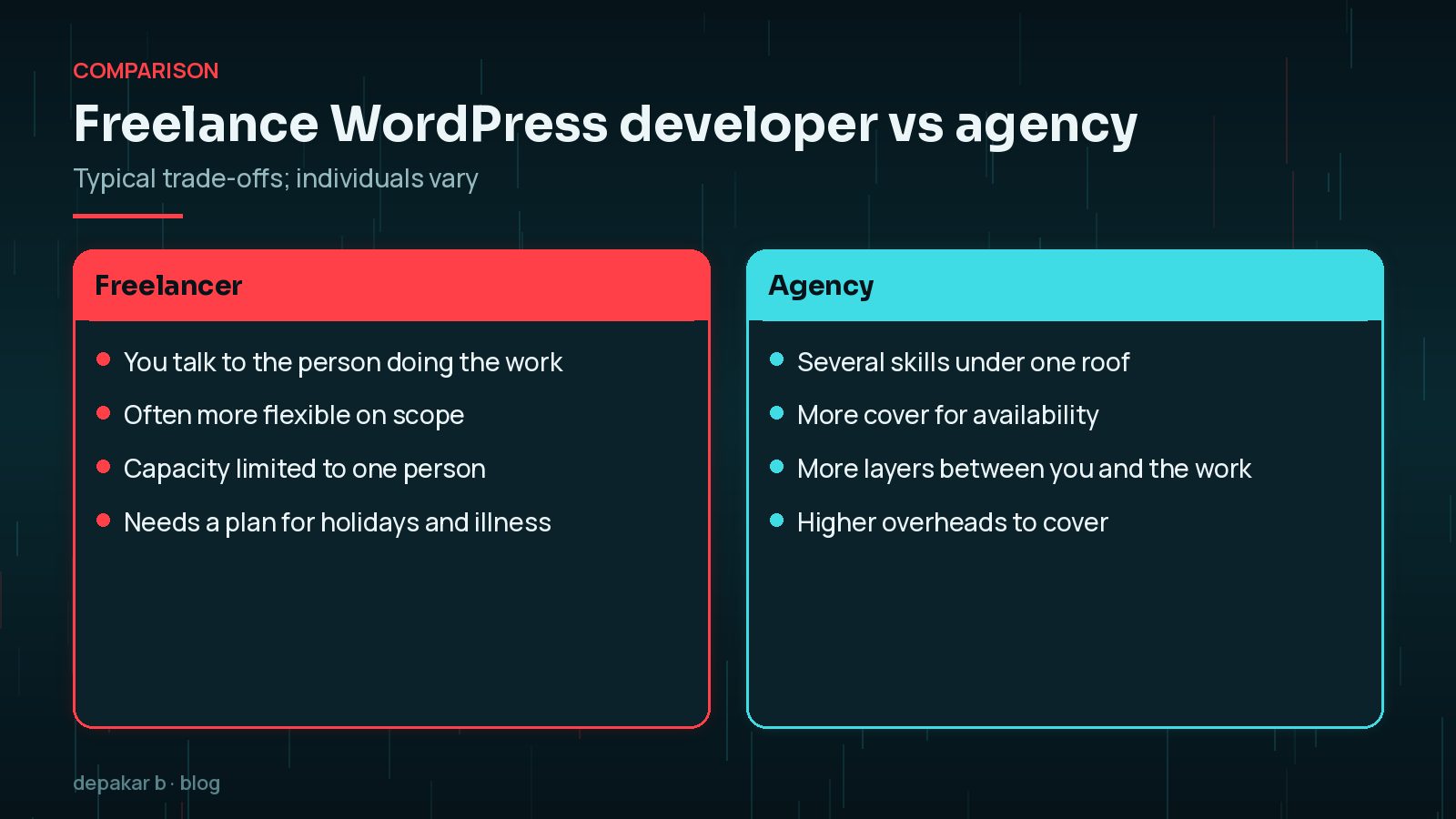
A freelance WordPress developer is usually one person, sometimes working with trusted collaborators. You typically get:
- Direct contact with the person writing the code.
- Flexibility on scope and process.
- Deep focus on the skills they specialise in.
- Limited capacity: they can only work on so much at once.
An agency is a team, often including designers, developers, project managers and marketers. You typically get:
- Several skills under one roof.
- More cover if someone is ill or leaves.
- Formal processes for larger projects.
- More layers between you and the people doing the work.
Many arrangements sit in between: small studios, freelancer networks, and agencies that subcontract to freelancers. Ask who will actually do the work.

Cost Factors and How They Differ
I won't quote typical prices, because they vary hugely by location, experience and scope. What differs is how the cost is built up:
- Overheads. Agencies carry office, management and sales costs that are reflected in their rates. Freelancers usually have lower overheads.
- Who's involved. An agency project may include design, project management and QA time. A freelancer may cover some of these themselves or leave them to you.
- What's included. Discovery workshops, content, SEO set-up, training and support may be in one quote and not another.
- Ongoing costs. Maintenance plans, hosting and change requests are priced differently by each.
Compare quotes on what's included, not the headline figure. My guide to WordPress website cost factors explains what drives the price either way.
Communication and Speed
With a freelancer, you usually talk directly to the developer. Questions get answered by the person who knows the code, and small changes can happen quickly. The risk is that one busy week or a holiday slows everything.
With an agency, a project manager often coordinates. That helps on complex projects with many people involved, but messages can pass through more hands, and small changes may need to fit into a schedule.
Either way, agree upfront how you'll communicate, how often you'll get updates, and how long replies should take.
It also helps to agree who on your side makes decisions. Projects slow down most when feedback comes from several people with different views, whichever option you pick. A single point of contact, a shared list of open questions and a regular check-in keep things moving, and they make it much easier to judge whether delays are on your side or theirs.
Skill Coverage: Design, Development, SEO and Content
A website project can need design, development, accessibility, SEO, copywriting, photography and hosting knowledge. No single person is expert at all of them.
- Freelancers are often strong in one or two areas. A good one will be honest about the rest and bring in trusted specialists or recommend them.
- Agencies can cover more areas in-house, but quality can vary between departments.
Whoever you choose, some standards should be non-negotiable. WordPress publishes coding standards for readable, consistent code, and WCAG is the recognised guide to web accessibility. Ask how they meet both, and ask to see an example of how they tested a past site for accessibility rather than taking it on trust.
Risk, Availability and Continuity
This is where the difference matters most for many businesses.
- Freelancer risk: if they are ill, overbooked or stop working, your project or support can stall. Ask what their cover plan is.
- Agency risk: staff change, and the person who built your site may have moved on. Knowledge can be lost between teams.
The best protection is the same for both: make sure you own and control your site. WordPress is open-source software licensed under the GPL, so there's no technical reason you can't take your site to another developer, as long as you hold the accounts and code.

Whichever you choose: keep admin access to your domain, hosting, WordPress and any premium plugin licences in your own name, and ask for code in a repository you can access.
Which Suits Which Project?
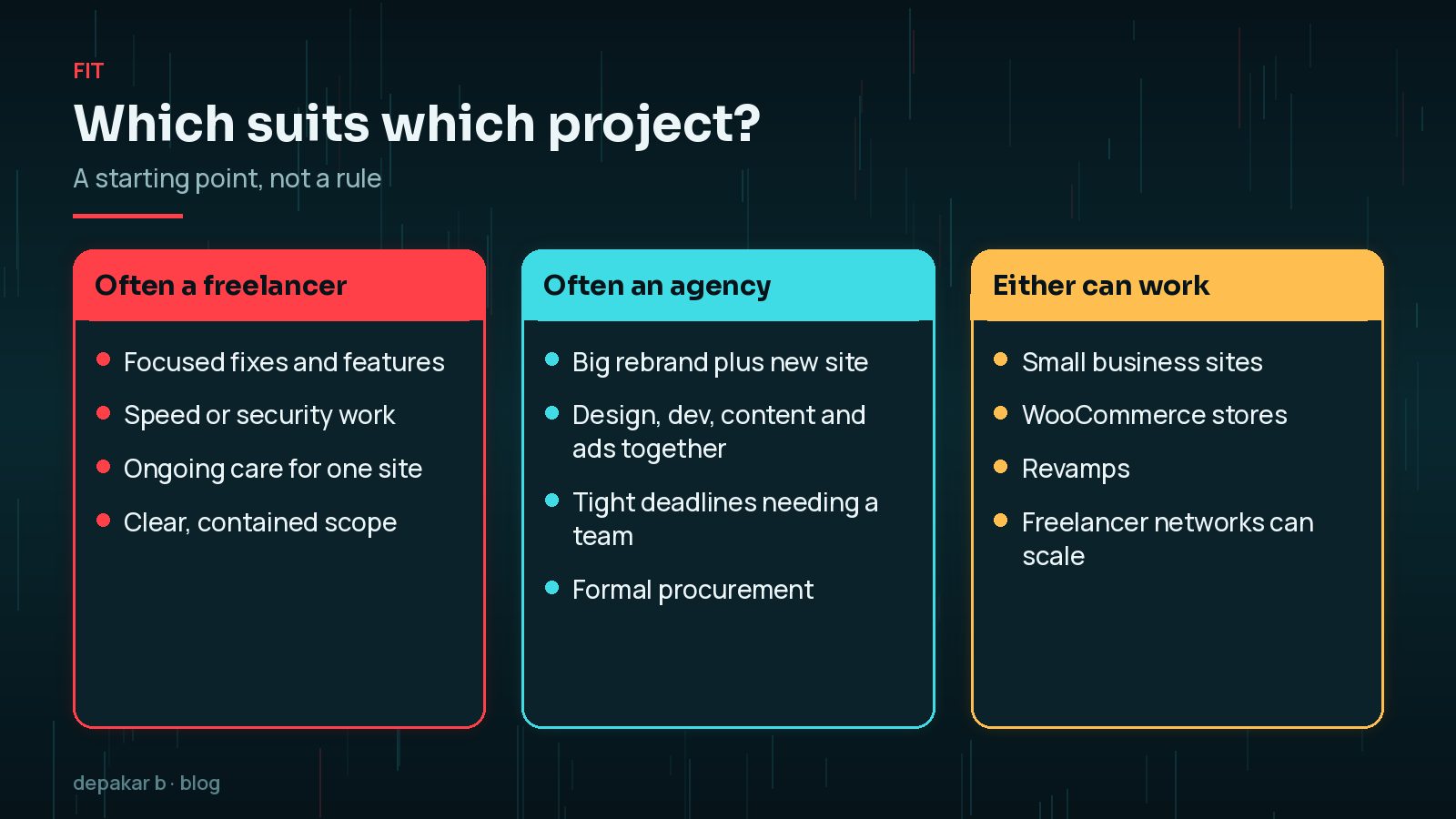
- Often a freelancer: focused fixes and features, speed or security work, ongoing care for one site, and projects with a clear, contained scope.
- Often an agency: a full rebrand with a new site, projects needing design, development, content and advertising together, tight deadlines needing several people at once, or formal procurement.
- Either can work: small business sites, WooCommerce stores and revamps. A freelancer with a good network can often scale to fit.
Whoever builds it, a process that scales matters more than the size of the team. See a WordPress development process that scales.
How to Vet a Freelance WordPress Developer or an Agency
The same questions work for both:
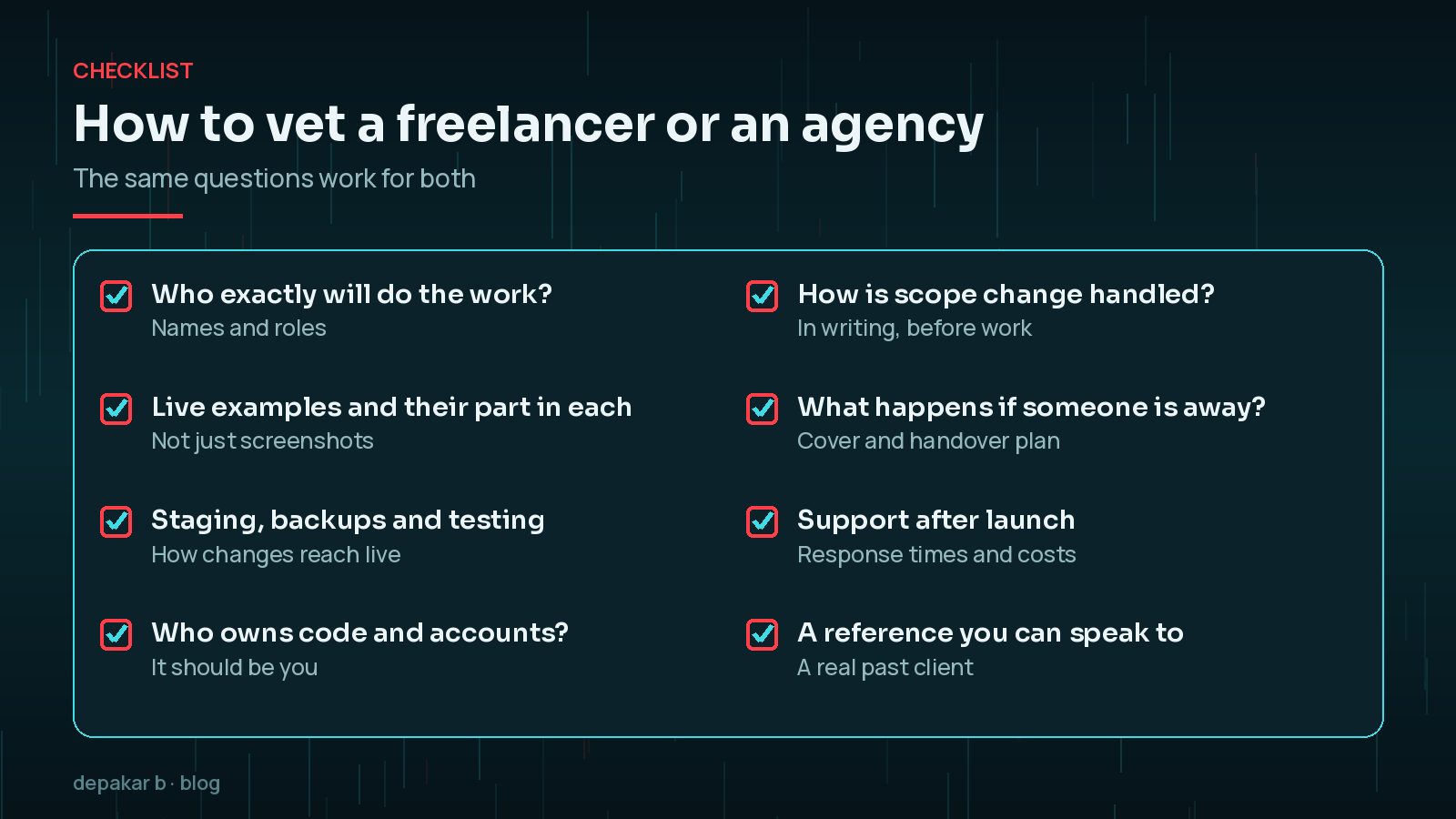
- Who exactly will do the work? Ask for names and roles.
- Can I see live examples, and what was your part in each?
- How do changes reach the live site? Ask about staging, backups and testing.
- Who owns the code and accounts? The answer should be you.
- How is scope change handled? In writing, before work starts.
- What happens if someone is away?
- What support is there after launch? Response times and costs.
- Can I speak to a past client?
A clear brief makes every answer easier to compare. Start with my WordPress website brief template, and use the checklist for hiring a WordPress developer when you shortlist.
Frequently Asked Questions
Is a freelance WordPress developer cheaper than an agency?
Often, because freelancers usually have lower overheads, but not always. Compare what each quote includes, such as design, testing, project management and support, rather than the headline price.
Is an agency safer than a freelancer?
Not automatically. Agencies have more cover for availability, but staff change too. The safest approach with either is owning your accounts and code and agreeing support in writing.
When should I choose an agency for WordPress?
When a project needs several disciplines at once, such as branding, design, content and advertising, has a tight deadline needing many people, or requires formal procurement.
When is a freelance WordPress developer the better choice?
For focused work with a clear scope, such as fixes, new features, speed or security work, or ongoing care for a site, where direct contact with the developer is valuable.
Can I switch from an agency to a freelancer later?
Usually, yes. WordPress is open source, so another developer can take over if you control the domain, hosting, WordPress admin, licences and code.
Final Thoughts
The freelance WordPress developer vs agency choice is less about which is better and more about fit. Match the option to your project's scope, skills and risk, ask the same vetting questions of both, and make sure you own everything at the end.
If a focused, direct working relationship suits your project, you can read more about how I work as a WordPress developer.
Choose for fit, vet carefully, and keep control of your site.
Official References
Sources checked on 29 October 2026: