
Business owners ask me the same question every few weeks: does AI generated content hurt SEO? Put another way, is AI generated content SEO-safe? The short answer is no, not by itself. Google's guidance focuses on whether a page helps people, not on which tool produced the words. The longer answer is that AI makes it very easy to publish lots of pages that help nobody, and that is exactly what Google's spam policies target.
This guide summarises what Google actually says, what changed in its guidance this month, where AI use turns into scaled content abuse, and a practical workflow for using AI on a small business blog without taking risks.
AI generated content SEO: what does Google actually say?
Google's guide to using generative AI content says these tools can be helpful for research and for adding structure to original content. It also warns that using them to generate many pages without adding value for users may break its spam policy on scaled content abuse.
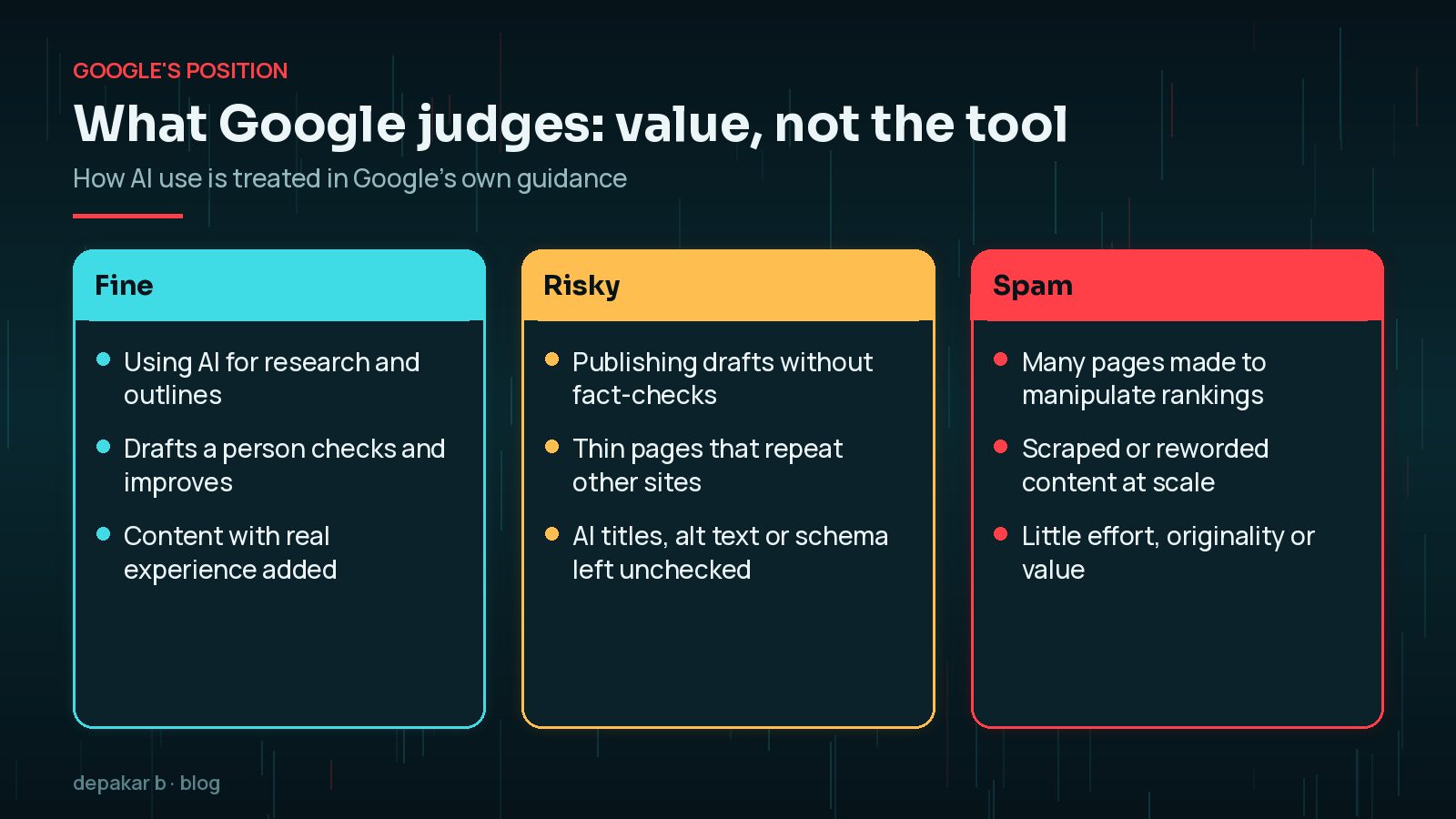
The same guide asks you to make sure AI-generated content is accurate and high quality, including the parts people often forget: titles, meta descriptions, structured data and image alt text. Language models predict likely words, so they can produce confident statements that are simply wrong.
What changed in Google's guidance in October 2026?
According to Google Search Central's documentation updates log, on 1 October 2026 Google updated its guide to using generative AI content with information from its Search Quality Rater Guidelines. The guide now points to the raters' sections on scaled content abuse and on content with little effort, originality or added value.
Two points are worth keeping in mind, as of late October 2026:
- The rules did not flip. The update explains how Google already thinks about low-value content rather than introducing a new penalty for AI.
- Raters do not set rankings. Google says rater feedback is used to evaluate its systems and does not directly affect how individual pages rank.
If you were hit by a recent spam update, my guide to recovering from the September 2026 spam update covers what to check first.
Where AI content crosses into scaled content abuse
Google defines scaled content abuse as generating many pages mainly to manipulate search rankings rather than to help users, and it applies no matter how the content is created. AI, freelancers, templates and scraping are all treated the same way.

Examples Google lists include using generative AI to create many pages without adding value, scraping feeds or search results, rewording other sites' content with synonyms, and stitching content from several pages together without adding anything. For a small business, warning signs look like:
- dozens of near-identical location or service pages with only the town name changed
- a sudden jump from one post a month to several a day
- posts on topics you have no connection to, published only for traffic
- articles nobody on your team has read in full
How E-E-A-T applies to a small business site
E-E-A-T stands for experience, expertise, authoritativeness and trustworthiness. Google says trust is the most important part, and that E-E-A-T is not a ranking factor in itself; its systems look for a mix of signals that line up with it. Topics that could affect people's health, money or safety get more weight.
The good news is that a small business has something AI does not: first-hand experience. Real jobs, real problems you have solved, photos you took and opinions you are willing to stand behind are exactly what generic AI text lacks. Google's helpful content guidance asks whether content shows first-hand expertise and whether it adds original information or analysis.
A safe workflow for AI-assisted blog posts
AI is a reasonable assistant for blank-page problems. It works well for outlines, checking what you might have missed and tidying up a draft. It should not be the final author.
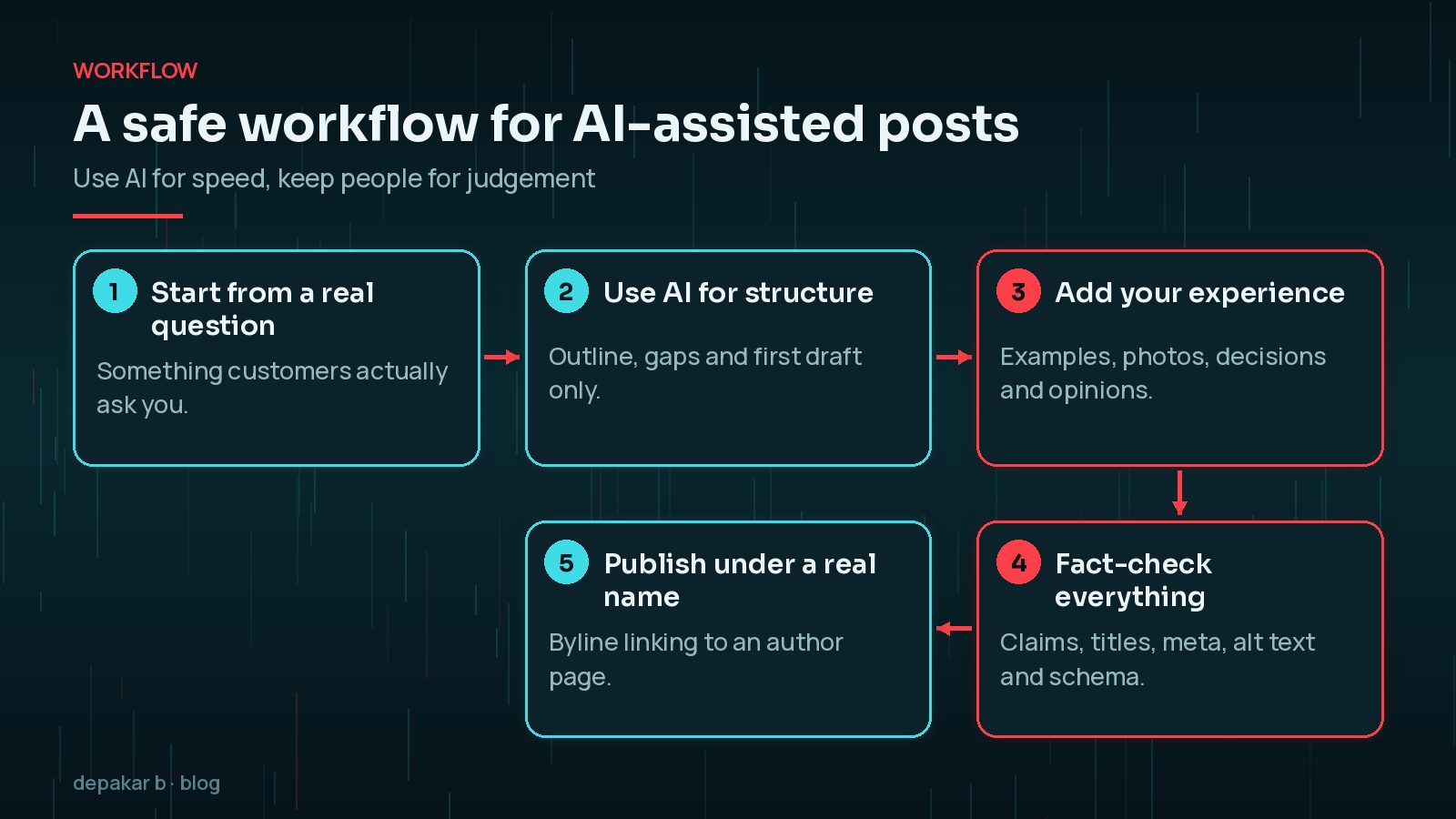
- Start from a question customers actually ask you, not a keyword list.
- Use AI to outline and produce a rough first draft.
- Rewrite the key parts with your own examples, decisions and images.
- Check every fact, number and link against an original source.
- Review the title, meta description, alt text and structured data by hand.

Good internal links also help readers and search engines understand how a post fits with the rest of your site; see my WordPress internal linking strategy.
Disclosure, bylines and author pages
Google suggests thinking about who created the content, how and why. Where readers would reasonably expect to know how something was made, explain it. It is not about hiding AI use; it is about being open with readers.
- Bylines: put a real person's name on posts and link to an author page that explains their background.
- How it was made: where it helps the reader, a short note that AI helped with a draft and a named person checked it is enough.
- AI images: Google's guide notes that Merchant Center requires AI-generated product images to carry the IPTC DigitalSourceType TrainedAlgorithmicMedia metadata.
Auditing old thin or AI-written posts
If you already published a batch of AI posts, do not panic and delete everything. Review them one by one and decide what each deserves.
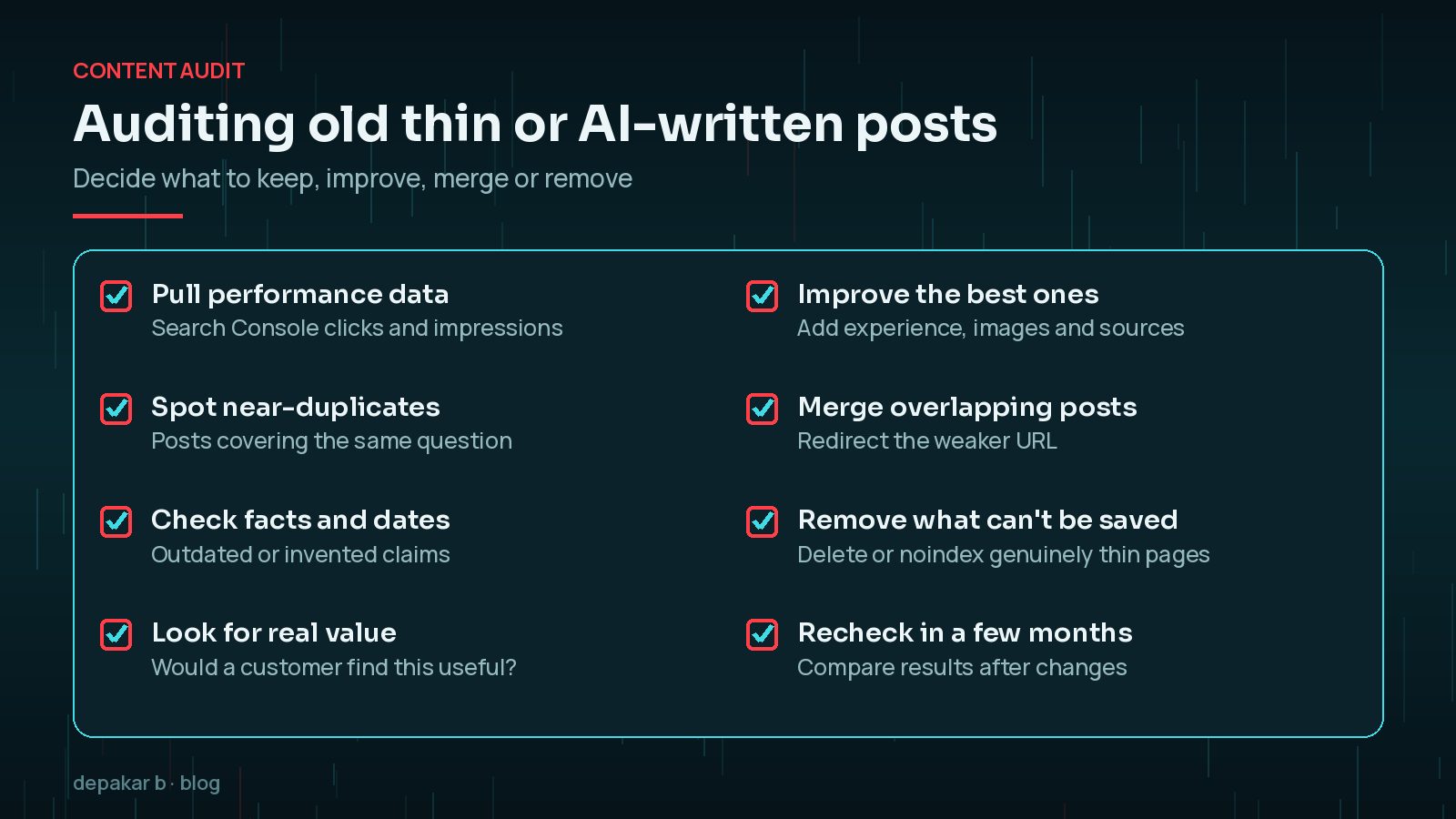
Pages that earn impressions but few clicks are often worth improving. Pages covering the same question can be merged with a redirect. Pages with no visitors, no links and nothing original are usually better removed. For how this fits with AI search, see my SEO, AEO and GEO guide and the guide to getting cited in AI Overviews and AI Mode.
Frequently Asked Questions
Does Google penalise AI generated content?
Not for being AI-written. Google acts against content made mainly to manipulate rankings, especially at scale, however it was created. AI content that is accurate and genuinely helpful is treated like any other content.
Should I label posts written with AI?
Google suggests explaining how content was created where readers would reasonably expect it. A short note that AI helped with a draft and a named person reviewed it is a sensible, honest approach.
Is it safe to use AI for meta descriptions and alt text?
Yes, if you check them. Google specifically asks site owners to make sure AI-generated titles, meta descriptions, structured data and alt text are accurate.
How many AI-assisted posts can I publish a month?
There is no safe number. The risk comes from publishing pages without adding value. A few well-checked posts based on real experience are worth more than many generic ones.
Will AI detectors affect my rankings?
Google's guidance focuses on quality and helpfulness rather than on detecting AI. Spend your effort on accuracy and original insight instead of trying to make text pass a detector.
Final Thoughts
AI generated content SEO is not a contradiction, as long as AI stays the assistant and you stay the author. Use it to speed up structure and drafting, then add the experience, checking and accountability that only your business can provide. Publish less, but make each post genuinely useful. If you would like help reviewing existing posts or planning content that earns trust, my SEO improvement service can help.
Official References
Sources checked on 29 October 2026: